stop
To cease moving or operating; to bring an activity to an end.
pots
Deep, round containers used for cooking food on a stove.
A levidrome becomes a different word when you read it backwards. Flip a few in the games, browse the fully defined dictionary, read eight Journal articles, and meet the six-year-old who named the whole thing.
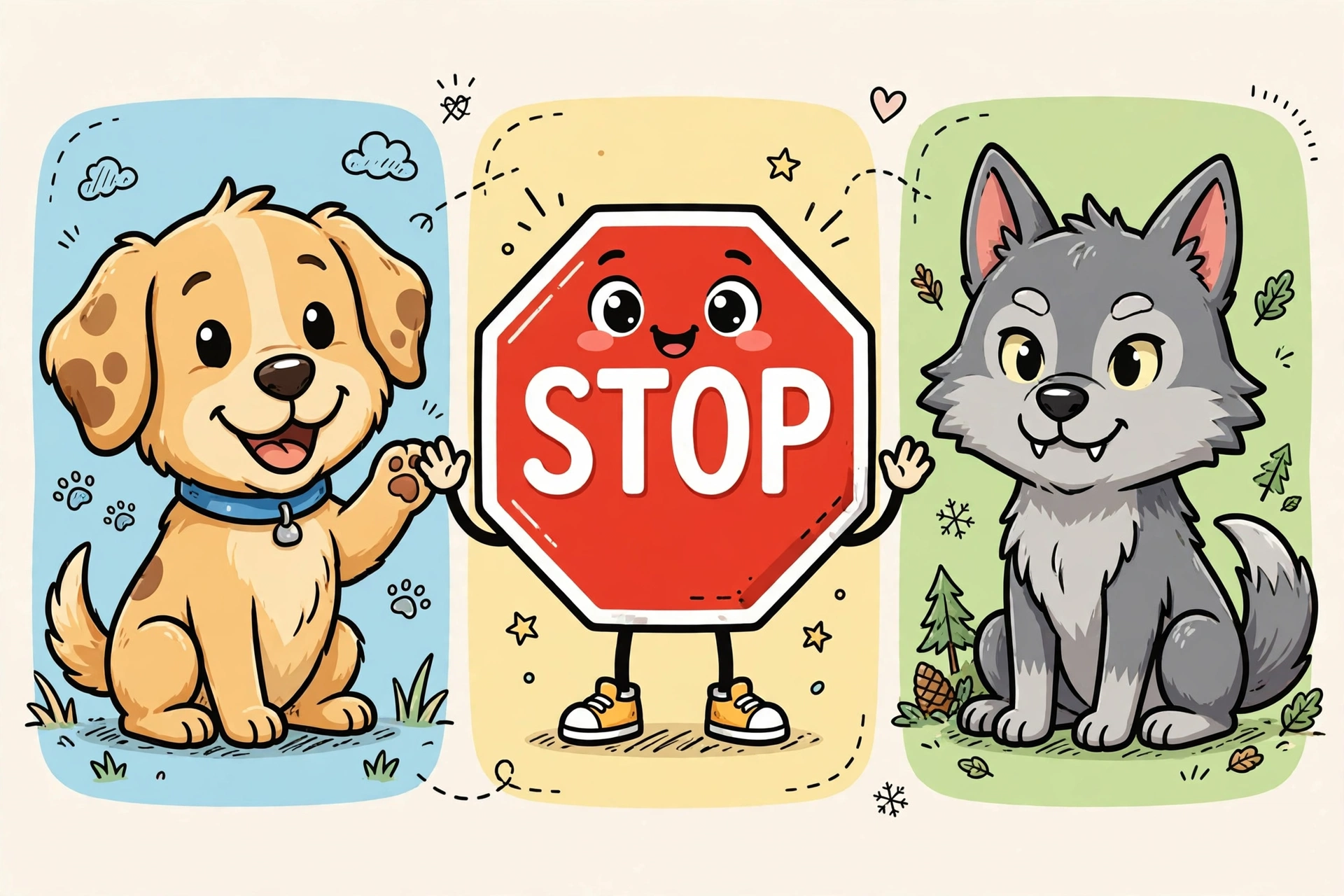
These three familiar sights all begin a levidrome pair.
The full explanation — the definition, the two-second test, how levidromes differ from palindromes and anagrams, and how to start spotting them yourself.
A levidrome is a word that becomes a different word, with a different meaning, when you read its letters in reverse order. Take the word on a stop sign: stop. Read it backwards, letter by letter, and you get pots — a word you could find in any kitchen, with nothing in common with traffic control except its four letters. Neither word is misspelled, neither is slang, and the trick needs no rearrangement: you may not shuffle the letters, swap any of them, or leave any out. Pure reversal is the whole game, and English, entirely by accident, is full of it.
More examples make the pattern click. Evil reversed is live. Loop reversed is pool. Drawer — the sliding box in your dresser — reversed is reward, the prize. A gateman guards the gate; reversed, he is wearing a nametag. And the most famous pair of all, the eight-letter summit of the pattern, is desserts and stressed: read either one backwards and you get the other, which generations of bakers have taken as a hint about cause and effect.
Checking a candidate takes two seconds and needs nothing but the word itself. Reverse it, exactly, last letter to first. Then ask two questions. First: is the result a real English word — the kind you could look up in a dictionary, not a name, a brand, or an abbreviation? Second: does it mean something different from the word you started with? If both answers are yes, you have a levidrome pair. If the reversal hands you the same word back, you have found something else — which brings us to the family tree.
Levidromes are most often confused with their two closest relatives, and the distinctions are worth learning because they are the whole point. A palindrome reads the same in both directions: noon, kayak, racecar. Reversal changes nothing; the mirror shows the same face. A levidrome is what happens when the mirror shows a stranger instead. An anagram, meanwhile, rearranges letters in any order it likes — listen becomes silent by shuffling. A levidrome allows one move only: the strict mirror flip. Every levidrome is technically an anagram of its partner, but only the perfect reversals earn the name. Word-game specialists also call the pattern a semordnilap — which is, fittingly, 'palindromes' spelled backwards — and our glossary maps the whole family, from ambigrams to pangrams.
Nothing in the pattern requires the two meanings to have anything to do with each other, and usually they don't — nap and pan are just neighbours by spelling. But the celebrated pairs are the ones where the meanings seem to comment. Evil and live read as opposites. Doom reversed is mood, which shrinks a catastrophe into passing weather. Devil reversed is lived — the whole arc of a reformed villain in ten letters. The letters are not trying to tell us anything; the human mind is a meaning-making machine, and it cannot resist reading a perfect reversal as a message. That collision — two unrelated ideas forced to share one spelling — is exactly why the pattern delights people, sticks in memory, and keeps collectors hunting. Our Journal explores the psychology in Why Your Brain Can't Resist a Backwards Word.
Browse the dictionary and a shape emerges: short pairs are plentiful, long pairs are precious. Of our 48 verified pairs, the great majority run to three, four, or five letters; only a handful reach six, one reaches seven twice over, and exactly one — desserts/stressed — reaches eight. This is arithmetic, not taste. An anagram can shuffle its way out of trouble, but a reversal fixes every letter in an exact mirrored position, so each additional letter is another independent chance for the landing to miss. A three-letter reversal has to clear a low bar; an eight-letter reversal has to be a spelling miracle eight times in a row. That is why collectors treat the long pairs as trophies, and why we wrote them their own hall of fame: Famous Long Levidromes.
The pattern is ancient — sentence palindromes built from levidrome pairs were being written centuries ago — but the everyday name is brand new. In 2017, six-year-old Levi Budd of Victoria, British Columbia, noticed STOP becoming POTS from the back seat of his mother's car and asked what such words were called. Nobody had a word for it, so he coined one from his own name plus the ending of palindrome. The campaign that followed — celebrity endorsements, national newspaper coverage, a lager named for the pair lager/regal — is told in full in The Six-Year-Old Who Put His Name in the Dictionary. The word is still travelling toward formal dictionary entry, a journey our Journal follows in How New Words Get Into Dictionaries; using it, as you just have, is literally how it gets there.
Four habits turn a casual reader into a collector. Start short: three- and four-letter words flip most often, so they reward beginners fastest. Read the world backwards: signs, menus, shop names, and book spines are fixed texts your eyes cross every day — the original discovery was made on a stop sign. Check both directions in a dictionary before you celebrate; both words must be real, current English with different meanings. Keep the list: date your finds, note where you spotted them, and rank them by how far the meaning travels when it flips. Teachers can find classroom versions of all four habits on our For Teachers page, and the answers to the questions everyone asks are collected in the FAQ.
Then put your eye in. The dictionary holds all 48 pairs with full definitions for both words; the games above will drill them into your reflexes; and the Journal goes deeper on every corner of the subject. The words are already out there, hiding in plain sight in the language you used today. You just have to look both ways.
Every game on this site is built from the same 48 verified pairs in the dictionary. Pick your favourite way to flip them.
Six words, six hidden partners. Type the word you get by reversing every letter — no rearranging allowed.
Play Reverse Six →Twelve cards, six levidrome pairs. Flip two at a time and remember which word hides where.
Play Memory Match →Ten levidromes hidden across, down, and diagonally in a 13-by-13 grid. Tap the first and last letter to mark each one.
Play Word Search →The flip dictionary holds 48 pairs, from two-letter quickies to the eight-letter showpiece. Here are eight favourites with their definitions — the full list is searchable, and every pair there is defined in full.
Eight long reads on the backwards word, the six-year-old who named it, the history of palindromes, crosswords, the long-pair hall of fame, how dictionaries work, and wordplay in the classroom. Start anywhere.
Levidromes 101
Read stop backwards and you get pots — a different word, a different meaning, built from exactly the same letters. The full tour: the definition, the distinctions from palindromes and anagrams, a shelf-by-shelf walk through the dictionary’s 48 pairs, and a four-step field guide to spotting levidromes of your own.
Read the article →The origin story
In the autumn of 2017, six-year-old Levi Budd was riding in the back seat of his mom’s car in Victoria, British Columbia, when he noticed something about a stop sign. What followed — a viral video, William Shatner, three newspapers, and an Imperial Regal Lager — is the story of how a word fights its way into the language.
Read the article →The psychology of wordplay
Show someone that stressed spelled backwards is desserts and watch their face. The eyebrows, then the laugh. That two-second moment reveals how minds work: we are prediction engines, and a levidrome breaks a prediction in a way we can instantly understand. Plus three exercises to train the instinct.
Read the article →Word history
Palindromes are at least two thousand years old — carved into stone at Pompeii, prescribed as medicine, traded in Victorian parlours. A tour of the reversible sentence from ancient Greece to 'A man, a plan, a canal — Panama!', and how sentence palindromes are secretly built from levidrome bricks.
Read the article →Puzzles & games
Reversible words are the load-bearing bricks of puzzle design — grid fill for constructors, a whole clue device in cryptics ('returned lager, fit for a king'), and free points in Scrabble for anyone who has memorised the short pairs. How the pros use the pattern, and how solvers can too.
Read the article →The hall of fame
Three-letter pairs are everywhere; eight-letter pairs are miracles. Meet the champions — desserts/stressed, deliver/reviled, gateman/nametag, drawer/reward — and the brutal arithmetic that makes every extra letter so much harder than the last.
Read the article →How language grows
Not by committee vote: by evidence. From the Oxford English Dictionary's millions of volunteer quotation slips to today's billion-word corpora, here is how a word actually earns its entry — with levidrome itself as the live case study, file still open.
Read the article →In the classroom
A levidrome turns spelling — the driest corner of the curriculum — into a treasure hunt. Why the flip hooks attention, which real skills it quietly teaches, how it scales from age six to sixteen, and where to find ready-made activities.
Read the article →STOP became POTS — but it wasn’t a palindrome. Six-year-old Levi Budd thought the phenomenon deserved its own name.
Levi, from Victoria, British Columbia, coined levidrome in 2017. The name combines Levi with the ending of palindrome. Unlike a palindrome, which reads the same both ways, a levidrome changes into a different word.
Palindrome describes a word or phrase that survives reversal unchanged. STOP and POTS do something else: reversal creates a second, unrelated word. Giving that pattern its own name makes it easier to notice, collect, discuss, and turn into a word game.
Levidrome remains a neologism—a relatively new proposed word—rather than a term used by every dictionary. That is part of its story. Language grows when people find a useful label, use it consistently, and pass it along.
This site uses the word in that practical spirit: to catalogue clear pairs, explain the distinction, and make the reversal pattern enjoyable to explore. The full story is in the Journal: The Six-Year-Old Who Put His Name in the Dictionary.